


The kinesiology muscle test
What is muscle testing in kinesiology ?
Definition of the muscle test
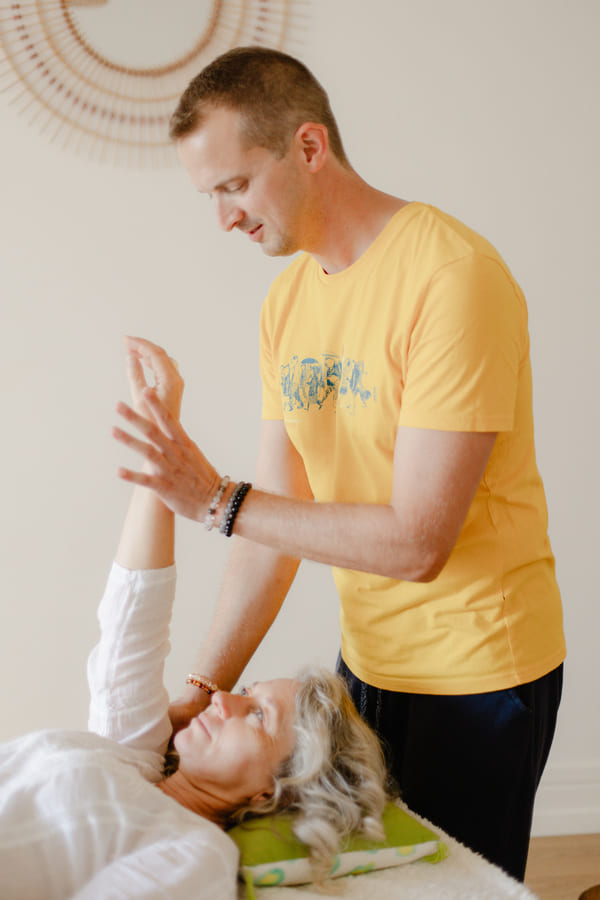
A muscle test in kinesiology is not a test of strength; it is a test of muscle tone. It consists of applying a specific, gentle pressure to a muscle or muscle group and observing the level of tonicity that the muscle is able to maintain in response to that pressure.
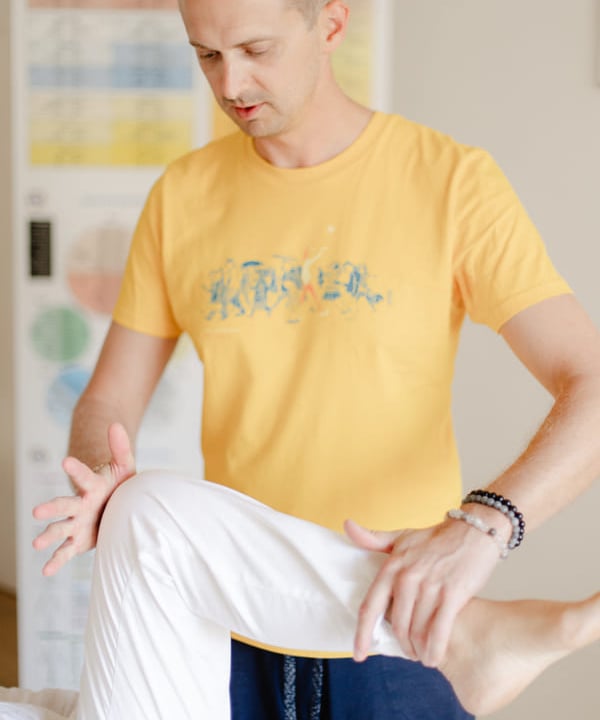
Take, for example, the front part of the shoulder muscle, the anterior deltoid: the client (or partner) holds their arm at an angle of about 45°. In a kinesiology muscle test, the muscle is neither fully contracted nor fully relaxed. It is held lightly under slight tension, in what is called a state of eutoia or neutral readiness. The practitioner then applies a gentle downward pressure on the limb, and the client is invited to keep the arm in place. When the muscle responds strongly and appears to “lock” or stay tonically firm, this suggests general homeostasis, i.e. internal balance.
Under stress (and stress can have many different causes), the muscular response can change: the tested muscle may lose tonicity and give way more easily. This loss of muscle tone is the information the practitioner reads during the test.


What can be tested ?
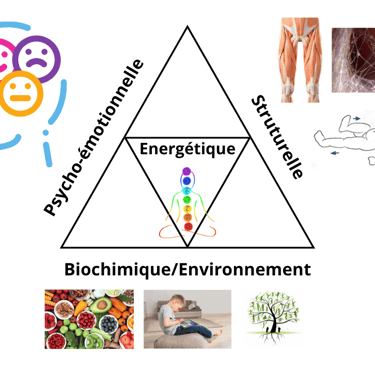
Kinesiology is a holistic approach that takes into account all dimensions of the person, often grouped into three main aspects forming a triangle of health:
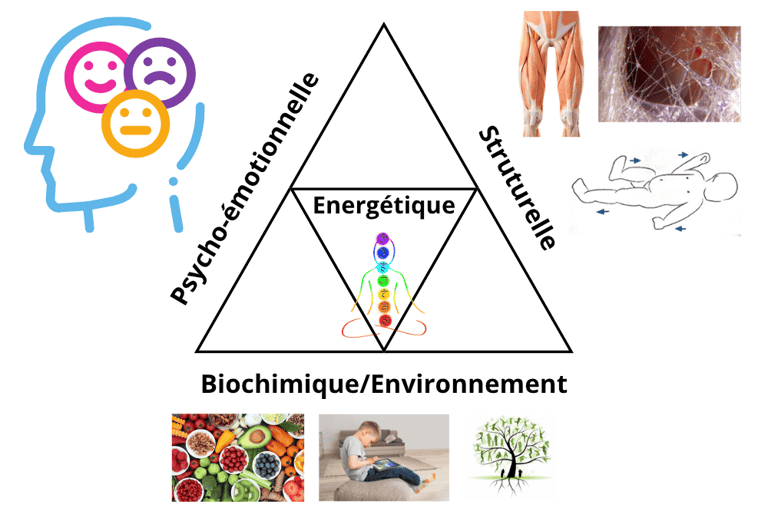
When the tested muscle is strong and tonically firm, and the client is then asked to think about, for example, their mother-in-law (a potential psycho‑emotional stress), the muscle may soften or lose tone. This signals to the kinesiologist that something has interfered with the normal neurological flow between the muscle and the central nervous system, preventing the muscle from functioning as it would in a state of balance. That interference can be linked to any stress associated with the word “mother-in-law” in the person’s system.
Similarly, it is possible to test a body area, a movement, a posture, or a painful area (examples of structural or mechanical stress).
Which muscles can be tested ?
The kinesiologist always checks first whether a muscle is healthy, i.e. pain‑free and functional for the person. If a muscle is painful or functionally compromised, the kinesiologist will avoid testing it, so as not to add further stress.
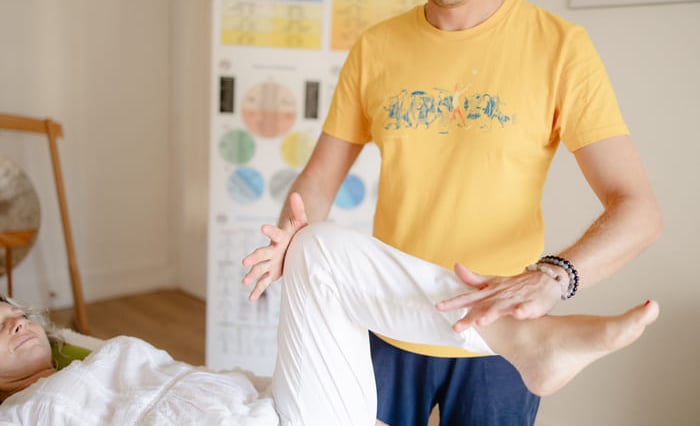
As mentioned above, muscle tests are usually performed on easily accessible muscles of the arm (commonly the anterior deltoid or brachialis), because they are convenient and not tiring for either practitioner or client.
During a session, the kinesiologist may also test other muscles that relate to specific movements or postures, sometimes associated with “movement memories”. In kinesiology, some muscles are considered linked to the meridians of traditional Chinese medicine. For example, by testing the clavicular part of the pectoralis major, the practitioner can indirectly access information related to the stomach, the stomach meridian, the Earth element (in Chinese medicine), and associated emotions such as dissatisfaction, frustration or disgust.
How does the kinesiology muscle test work ?
A neur-muscular response
Some practitioners see the muscle test as a reflex response of the nervous system. When a stimulus (for example, a mental image, a question, or a meridian point) is neutral or balanced, the nervous system keeps the muscle strong. If the stimulus is stressful or unbalanced, the muscle response weakens.
The muscle test can therefore be viewed as a way of accessing the autonomic or central nervous system. By introducing different kinds of information—thoughts, emotions, images, energy points—the practitioner may influence or detect the nervous system’s response, which is then expressed through the muscle’s strength.
An energetic approach
Kinesiology is also based on the idea that the body has a dynamic energy system, often linked to the notion of Qi in traditional Chinese medicine. When there is a disturbance or imbalance in the flow of Qi, this may be reflected as a weakening of muscle tone. The muscle test can then be understood as an indirect way of detecting these energetic imbalances.
The muscular response may also be linked to unconscious processes, where the body subtly reacts to psychological or emotional stimuli, revealing hidden conflicts or emotional blocks. This is mirrored in everyday expressions such as “my arms drop at my sides”, “my legs feel like jelly”, or “boiling with anger”.
Despite around 60 years of kinesiology practice, the scientific community has not yet fully validated the muscle test in terms of precise physiological or neurophysiological mechanisms. Some researchers suggest that it may rely at least in part on psychological effects or perceptual bias.
This is why no medical diagnosis can be made using the muscle test, and why no statement about the body’s condition can be claimed as 100% certain.
The advantages of the kinesiology muscle test
Thanks to the muscle testing technique, the kinesiologist can ask direct questions to the body. By “body”, we mean the integrated whole of the person’s physiological, emotional, mental and spiritual dimensions. This is possible because muscular response is largely governed by the subconscious.
The muscle test would be of little use if it simply confirmed answers that the person is already aware of on a conscious level. Its real value lies in highlighting unconscious, subconscious or bodily information—parts of the story that the person may not yet have recognised or put into words.
“If you listen to your body when it whispers, you will not have to hear it scream.” — Tibetan wisdom
Office : Centre paramédical, 6 avenue Durante, 06000 Nice






James Machu - Kinesiologist

Kinesiology Privacy policy Legal notice Book now
James Machu © 2026